
Why Some Spine Problems Are Difficult to Detect
Certain spinal problems aren’t always apparent on conventional imaging or detectable through a standard physical exam. Some patients deal with ongoing discomfort, muscle weakness, or the unsettling sensation that their back is about to “buckle,” even when their first round of tests comes back looking unremarkable. At Comprehensive Spine Care in New Jersey, patients frequently ask how spine experts pinpoint subtle forms of instability that may slip past initial assessments.
This kind of concealed instability develops when vertebrae shift improperly during movement, even though they look properly aligned when the body is still. Since most imaging tests only capture a single static view of the spine, these motion-dependent irregularities can easily be missed. Detecting this type of hidden instability sheds light on why specialized testing and a thorough clinical workup are frequently required when symptoms linger despite normal initial results — a process that benefits patients across Westwood, Bloomfield, Bridgewater, and East Brunswick alike.
What Spinal Instability Means
Spinal instability refers to excessive or abnormal movement between vertebrae. The spine is designed to allow controlled motion while maintaining enough stability to protect the spinal cord and surrounding nerves. Ligaments, discs, joints, and muscles all work together to maintain this balance.
When one or more of these supporting structures weaken or become damaged, the vertebrae may shift more than normal during movement. This excessive motion can irritate nerves, strain muscles, and place uneven stress on the joints and discs.
In some individuals, instability is obvious because the spine shows visible misalignment on imaging. In others, however, the abnormal movement occurs only during certain positions or activities, making the condition more difficult to detect.
Why Hidden Instability Often Goes Undiagnosed
Hidden instability can be challenging to identify because symptoms may fluctuate throughout the day. Individuals often report pain that worsens during movement but improves while resting. Since traditional imaging studies are frequently performed while lying still, the abnormal movement may not appear during testing.
Another reason hidden instability is overlooked is that symptoms can resemble other spine conditions. Pain, stiffness, muscle spasms, or nerve irritation may initially be attributed to muscular strain or disc degeneration rather than instability itself.
Subtle instability may also develop gradually. Over time, supporting structures weaken, allowing small shifts in vertebral motion that are difficult to detect early in the process.
Conditions That May Contribute to Instability
Several spinal conditions may increase the likelihood of hidden instability. Degenerative disc changes are one common factor. As discs lose height and flexibility, the spine may become less capable of maintaining proper alignment during movement.
A herniated disc may also contribute when disc damage affects the structural support between vertebrae. In some cases, instability develops after injury or repetitive strain weakens the supporting ligaments of the spine.
Structural conditions such as spondylolisthesis are more obvious forms of instability in which one vertebra shifts forward relative to another. However, smaller degrees of abnormal movement may exist even before measurable slippage becomes visible on routine imaging.
How Symptoms May Suggest Hidden Instability
Symptoms of hidden instability often vary depending on movement and posture. Some individuals describe a feeling that the back or neck “slips” or becomes unstable during activity. Others notice pain that worsens when transitioning between positions, such as moving from sitting to standing.
Muscle tightness and spasms are also common because surrounding muscles attempt to compensate for the lack of structural support. These muscles may remain constantly engaged in an effort to stabilize the spine.
When instability irritates nearby nerves, symptoms may include radiating pain, numbness, or weakness. Conditions such as spinal stenosis may occur alongside instability, increasing pressure on nerve pathways and contributing to neurological symptoms.
The Role of Flexion and Extension Imaging
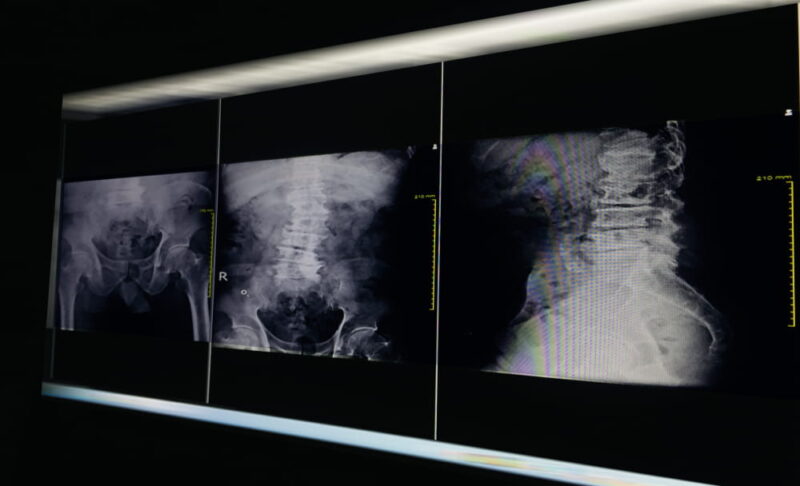
One of the most important tools for diagnosing hidden instability is flexion-extension imaging. Unlike standard X-rays taken in a neutral position, these studies capture the spine while bending forward and backward.
This movement-based imaging allows physicians to evaluate whether vertebrae shift excessively during motion. Small changes in alignment that are invisible at rest may become apparent when the spine moves through different positions.
Flexion-extension studies are commonly used in both the cervical and lumbar spine when instability is suspected. These tests help determine whether abnormal movement contributes to the patient’s symptoms.
How MRI and CT Imaging Support Diagnosis
MRI scans provide detailed information about discs, ligaments, nerves, and soft tissues surrounding the spine. While MRI images are usually obtained while lying still, they remain valuable because they reveal structural changes that may contribute to instability.
For example, MRI scans may show disc degeneration, ligament injury, or narrowing around nerve pathways. These findings help physicians understand why abnormal motion may be occurring.
CT scans are particularly useful for evaluating bone structures. They may help identify fractures, joint degeneration, or subtle alignment changes that are less visible on other imaging studies.
By combining MRI, CT, and movement-based imaging, spine specialists develop a more complete understanding of how the spine behaves during both rest and motion.
How Physical Examination Helps Identify Instability
Imaging alone is not always enough to diagnose hidden instability. A detailed physical examination often provides important clues about how the spine functions during movement.
Physicians may assess posture, balance, flexibility, and muscle control. Certain movements may reproduce symptoms or reveal areas where the spine lacks stability. Neurological testing also helps determine whether nerves are being affected by abnormal movement.
Observing how symptoms change during specific activities can provide valuable information that complements imaging findings.
Treatment Approaches After Diagnosis
Treatment depends on the severity of instability and the degree of nerve involvement. Many individuals begin with conservative care aimed at improving muscular support around the spine.
Educational resources on physiatry and pain management explain how strengthening programs and movement-based therapies may help stabilize the spine and reduce symptoms.
When instability causes significant nerve compression or structural dysfunction, surgical stabilization may be considered. Procedures such as lateral interbody fusion may help restore alignment and reduce abnormal movement between vertebrae.
The goal of treatment is to improve spinal stability while protecting nerve structures and supporting long-term function.
Signs That May Suggest Hidden Instability
Certain patterns of symptoms may indicate that instability is contributing to spinal discomfort:
• Pain that worsens during movement or position changes
• A sensation of the spine “slipping” or “catching”
• Muscle spasms that occur repeatedly
• Symptoms that fluctuate depending on posture
• Numbness, weakness, or radiating pain associated with movement
These symptoms may prompt further evaluation using advanced diagnostic techniques.
Understanding How Specialists Detect Hidden Instability
Concealed spinal instability illustrates an important point: certain spine problems only reveal themselves when the spine is observed in motion, not while it’s stationary. By pairing a hands-on clinical assessment with sophisticated imaging methods like flexion-extension X-rays, magnetic resonance imaging, and computed tomography scans, specialists are able to uncover slight instabilities that would likely escape notice with standard testing alone. Recognizing what each of these diagnostic tools contributes helps clarify why ongoing spinal symptoms occasionally call for a deeper, more thorough investigation. For residents of Westwood, Bloomfield, Bridgewater, and East Brunswick who wish to learn more about how this elusive form of instability is detected and treated, Comprehensive Spine Care in New Jersey offers resources to guide patients through the process.
Sources
Panjabi MM (1992). The stabilizing system of the spine. Journal of Spinal Disorders.
White AA, Panjabi MM (1990). Clinical biomechanics of the spine. Journal of Biomechanics.
Fritz JM, et al. (2005). Clinical examination findings in patients with lumbar instability. Spine.